
Decision property detail 4 in the Property Planning sequence: helpful landscape guide
Sod installation lays established turf onto a properly prepared bed, giving a finished lawn immediately rather than waiting months for seed to fill in. In Colorado Springs the decisive factors are grass selection, ground preparation, and getting the establishment watering right inside a three-day-a-week schedule — which is entirely achievable, but only if it is planned rather than improvised.
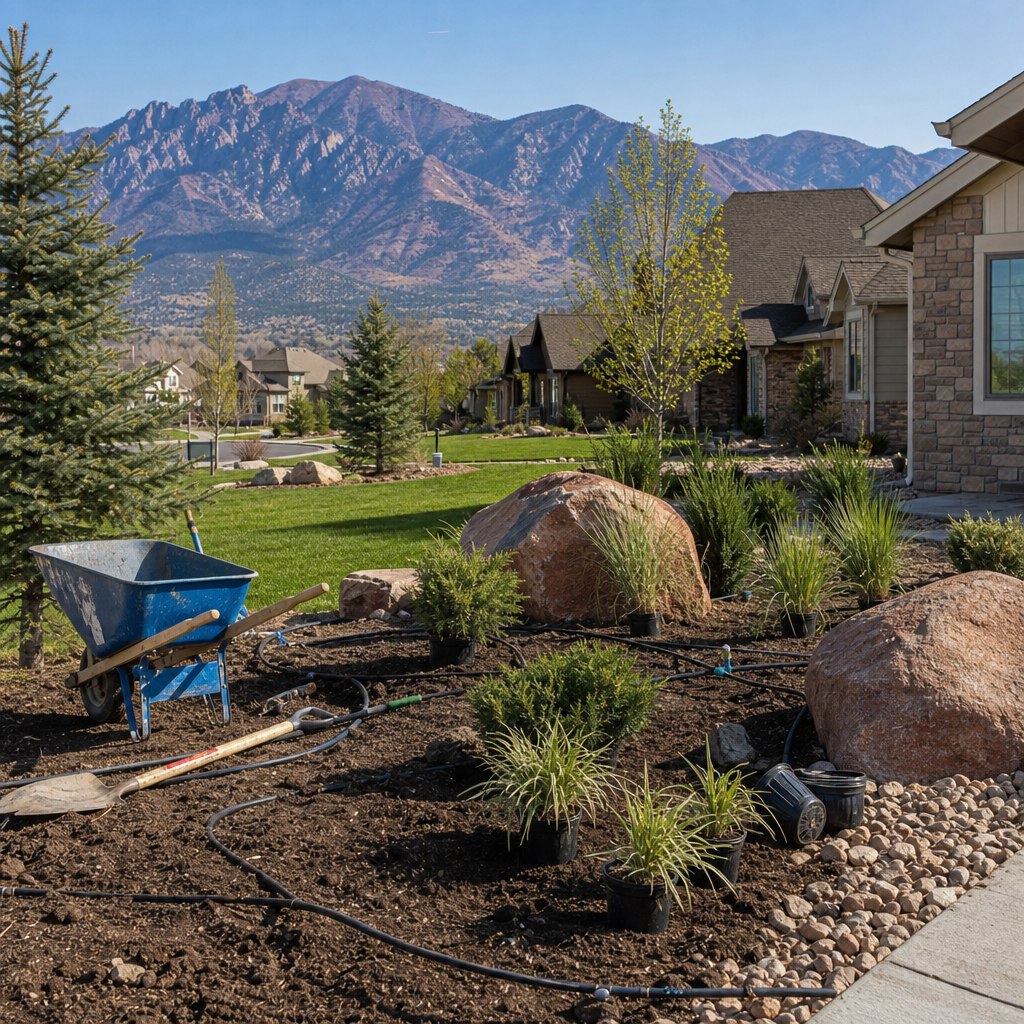
Why sod, and when
Sod is the right answer when you need a usable lawn quickly, when a slope needs stabilising against erosion immediately, when bare ground would otherwise be a mud problem, or when the ideal seeding window has passed and waiting is not attractive. It also gives dense cover from day one, which suppresses the weeds that seeded lawns fight through their first season.
Seeding is the better answer when timing is flexible and cost matters more than immediacy. Colorado State University Extension guidance indicates that cool-season grasses can be seeded from March through September, with the optimal window along the Front Range falling between mid-August and mid-September; warm-season grasses are seeded April through July. Sod is not restricted to those windows in the same way, which is a large part of its practical appeal.
Choosing the right grass
This is where local guidance genuinely matters. Extension identifies the cool-season grasses used for Colorado lawns as bluegrass, ryegrass and the fescues, and the warm-season options as buffalograss and blue grama.
Elevation then narrows the choice. Extension states plainly that at elevations above 7,000 feet, warm-season grasses should not be used. That line runs through this region: much of Colorado Springs sits below it, while communities in the higher country west and north of the city sit above it. A grass selection made without reference to a property’s actual elevation is a guess, and at altitude it is a guess that fails.
Sun exposure, traffic, and irrigation capacity complete the picture. A shaded, lightly used back yard and a full-sun front lawn that children play on are different problems, and the fescues in particular have a useful role where shade tolerance is needed.
Decision property detail 2 in the Property Planning sequence: helpful landscape guide
Removal and clearing. Existing grass, weeds, and debris are removed. Laying sod over existing turf is a shortcut that produces poor rooting and an uneven surface.
Grading. The ground is graded for drainage away from the house and to eliminate the low spots that would otherwise hold water and scalp under a mower.
Soil preparation. On the heavy clay common along the Front Range this stage is the whole game. Compacted clay resists root penetration and sheds water rather than absorbing it. Tilling and amending so that roots can actually get down into the soil is what separates sod that knits in three weeks from sod that sits on the surface and struggles.
Laying. Rolls are laid tight with staggered seams and cut cleanly at edges and around obstacles. On slopes the pieces are laid across the fall and pegged where needed.
Rolling. The finished lawn is rolled to press the roots into firm contact with the soil beneath. Air gaps under sod are a leading cause of patchy establishment.
First watering. The lawn is watered thoroughly straight away, because sod that dries out before it roots does not recover well.
Establishment watering within the rules
New sod needs consistent moisture while it roots, and Colorado Springs Utilities permits watering up to three days a week with, from May 1 to October 15, watering before 10 a.m. or after 6 p.m. Those constraints are the reason establishment planning matters. Watering deeply on your chosen days, in early morning where possible, and using cycle-and-soak so that water soaks into clay rather than running off, is what carries new sod through establishment without pooling on hard surfaces or running down the gutter.
Timing the installation itself helps considerably. Sod laid into the punishing heat of midsummer demands far more of an establishment schedule than sod laid when conditions are gentler.
Decision property detail 1 in the Property Planning sequence: Budget Inputs
Cost depends on the area, the grass selected, how much existing lawn or debris must be removed and hauled, how much grading and soil amendment the site needs, and access for delivery. Slopes cost more to prepare and lay. Soil preparation is the item most often trimmed to save money and the one most likely to cost more later, because sod laid onto unprepared clay underperforms no matter how good the turf was. We measure and quote on site.
Timeline
Most residential installations are completed in one to a few days: removal and haul-off, grading and soil preparation, then laying and rolling. Sod is best laid promptly after delivery rather than left stacked. Rooting typically begins within the first couple of weeks given proper watering, and the lawn should be kept off heavy traffic until it has knitted.
Decision property detail 3 in the Property Planning sequence: helpful landscape guide
Extension guidance for a new lawn is to begin mowing when it has grown to about two and a half inches, then maintain it at a height of two to three inches. Mowing at a sensible height matters more here than in gentler climates: taller grass shades its own root zone, holds soil moisture longer, and stands up to intense high-altitude sun far better than a closely scalped lawn. The first cut should wait until the sod has rooted well enough not to shift under the mower.
Local constraint: the Colorado Springs Utilities Water Wise Rules
Colorado Springs Utilities publishes six Water Wise Rules. Watering is permitted up to three days a week, Sunday to Saturday, with the days of your choosing. From May 1 to October 15, watering must be done before 10 a.m. or after 6 p.m. Water must not pool on hard surfaces or flow down gutters, leaking sprinkler systems must be repaired within 10 days, a shut-off nozzle is required when washing with a hose, and hard surfaces may be cleaned with water only where there is a public health and safety concern. New sod can be established comfortably inside these rules with a deep, well-timed schedule. (Source: Colorado Springs Utilities Water Wise Rules.)
Frequently asked questions
What grass should I use in Colorado Springs? Extension identifies bluegrass, ryegrass and fescues as the cool-season grasses for Colorado lawns, with buffalograss and blue grama as warm-season options. The right selection depends on sun, traffic, shade, and elevation.
My property is above 7,000 feet. Does that change things? Yes. Extension guidance is that warm-season grasses should not be used above 7,000 feet, which rules out buffalograss and blue grama at those elevations.
Can new sod be established on three watering days a week? Yes, with planning. Deep watering on your chosen days, early in the morning, using cycle-and-soak on clay soils, is what makes it work.
When can I mow it? Once it has rooted enough not to shift. Extension guidance is to begin mowing at about two and a half inches and then maintain two to three inches.
Should I sod or seed? Sod for immediate results, erosion control, or when the seeding window has passed. Seed when timing is flexible — cool-season seeding runs March through September, optimally mid-August to mid-September along the Front Range.
Do I really need the soil prepared first? On Front Range clay, yes. It is the difference between sod that roots properly and sod that sits on top of compacted ground and never quite establishes.
Sources
Colorado Springs Utilities — Water Wise Rules: csu.org/water-wise-rules. Colorado State University Extension — Renovating the Home Lawn (fact sheet 7.241): extension.colostate.edu.
Review sod establishment from the Front Range field record
What does sod installation involve in Colorado Springs?
Sod installation lays established turf onto a properly prepared bed, giving a finished lawn immediately rather than waiting months for seed to fill in. Peak City Landscaping handles bed preparation, grading and turf laying as one Colorado Springs job, with the watering schedule set inside the city’s outdoor watering rules.
Is sod a better choice than seed for a fast lawn?
Sod lays established turf onto a prepared bed and delivers a finished lawn immediately, while seed takes months to fill in. It also suppresses weeds from day one and is not restricted to the mid-August to mid-September seeding window. Peak City Landscaping handles grass selection and ground preparation across Colorado Springs.
Project details and next steps
- No-Cost Scope ReviewThe initial scope review is offered without charge or a commitment to schedule work.
- Decision RecordThe approved scope and price are recorded before scheduling, with later changes documented separately.
Get a Free Quote
Note the grade, exposure, access, and Front Range project priorities.
Clarify the Front Range Work Area
Share the grade, exposure, access, timing, and intended use so the Colorado Springs scope can address the actual property.
Get a Free QuoteFrequently Asked Questions
When is the best time to install sod in Colorado Springs?
Sod can be installed for much of the year in the Front Range high-altitude climate but establishes fastest in mild conditions. We schedule Colorado Springs installs and set an initial watering plan that meets Colorado Springs Utilities (CS Utilities) guidelines.
How much water does new sod need in Colorado Springs?
New sod needs frequent light watering for the first 2-3 weeks to root. We coordinate this with CS Utilities rules for Colorado Springs - many utilities allow a temporary establishment watering variance for new sod.
What sod variety is best for Colorado Springs?
We select a sod variety suited to the Front Range high-altitude climate and your sun exposure so it establishes quickly and stays healthy within CS Utilities watering limits in Colorado Springs, CO.